1.7 This Document & Its Conventions
The 2025 Game Manual is a resource for all FIRST Robotics Competition teams for information specific to the 2025 season and the REEFSCAPE game. Its audience will find the following detail:
- a general overview of the REEFSCAPE game,
-
detail about the REEFSCAPE playing
- a description of how to play the REEFSCAPE game,
- rules (related to safety, conduct, game play, inspection, event, etc.), and
- a description of how teams advance at 2025 tournaments and throughout the season
The intent of this manual is that the text means exactly, and only, what it says. Please avoid interpreting the text based on assumptions about intent, implementation of past rules, or how a situation might be in “real life.” There are no hidden requirements or restrictions. If you’ve read everything, you know everything.
Specific methods are used throughout this manual to
highlight warnings, cautions, key words, and phrases. These conventions are
used to alert the reader to important information and are intended help teams
in constructing a
Links to other section headings in this manual, external articles, and rule references appear in blue underlined text.
Key words that have a particular meaning within the context of the FIRST Robotics Competition and REEFSCAPE are defined in section 15 Glossary and indicated in ALL CAPS throughout this document.
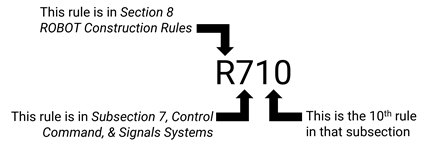
The rule numbering method indicates the section, subsection, and position of the rule within that subsection. The letter indicates the section in which the rule is published.
- Q for Section 6.7.1 Question Box
- G for Section 7 Game Rules
-
R for Section 8
- I for Section 9 Inspection & Eligibility
- T for Section 10 Tournaments
- C for Section 13 FIRST Championship Tournament
- E for Section 14 Event Rules
The following digit(s) represents the subsection in which the rule can be found. The final digits indicate the rule’s position within that subsection.
Figure 1‑3 Rule numbering method
Warnings, cautions, and notes appear in blue boxes. Pay close attention to their contents as they’re intended to provide insight into the reasoning behind a rule, helpful information on understanding or interpreting a rule, and/or possible “best practices” for use when implementing systems affected by a rule.
While blue boxes are part of the manual, they do not carry the weight of the actual rule (if there is an inadvertent conflict between a rule and its blue box, the rule supersedes the language in the blue box).
Imperial dimensions are followed by comparable metric dimensions in parentheses to provide metric users with the approximate size, mass, etc. Metric conversions for non-rules (e.g. dimensions) round to the nearest whole unit, e.g. "17 in. (~43 cm)” and “6 ft. 4 in. (~193 cm).” Metric conversions in rules round such that the metric dimension is compliant with the rule (i.e. maximums round down, minimums round up). The metric conversions are offered for convenient reference only and do not overrule or take the place of the imperial dimensions presented in this manual and the official drawings (i.e. dimensions and rules will always defer to measurements using imperial units).
Rules include colloquial language, also called headlines, in
an effort to convey an abbreviated version of the rule or rule set. There are
two versions of headline formatting. Evergreen rules, or rules which are
expected to go relatively unchanged from season to season, are indicated with a
leading asterisk and their rule number and headline are presented in bold green text. “Relatively unchanged” means
that the overall intent and presence of the rule from season to season is
constant, but game specific terms may be updated as needed (e.g. changing
Power Cells to
Team resources that aren’t generally season specific (e.g.,
what to expect at an event, communication resources, team organization
recommendations,
 Buy me a hot chocolate